IELTS - PTE

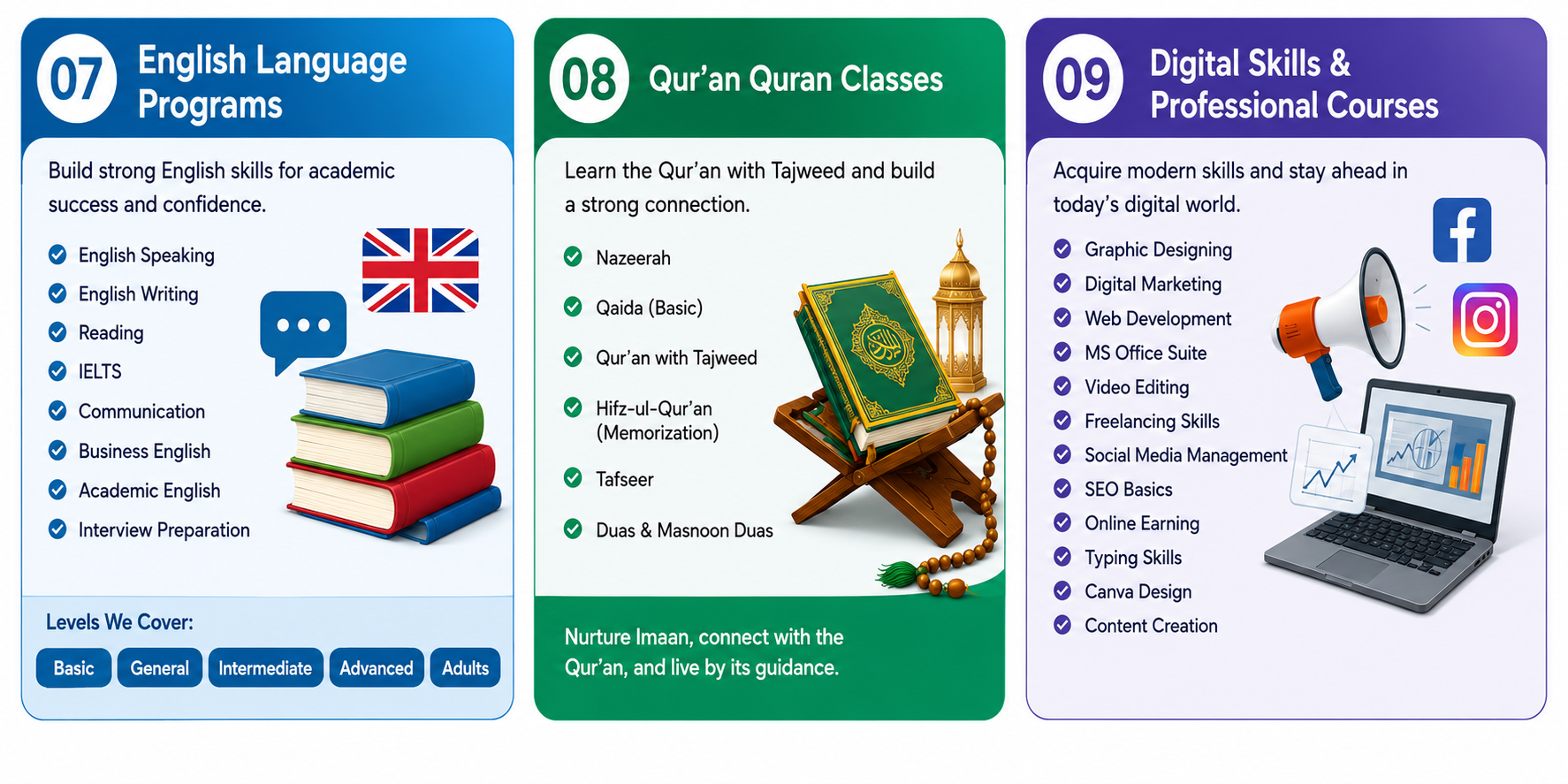
IELTS: Academic and General


The IELTS (International English Language Testing System) has two types of exams: 
Academic and General Training.
Both versions assess four key
English language skills:

Listening, Reading, Writing, and Speaking

IELTS Academic:

This test is for people applying for higher education or professional registration in an English-speaking environment. It reflects the features of academic language and assesses whether you are ready to begin studying or training in an English-speaking setting.

IELTS General Training

This test is for those going to English-speaking countries for secondary education, work experience, or training programs. It focuses on basic survival skills in broad social and workplace contexts.

IELTS exam format for both the Academic and General Training modules, covering all four components

The IELTS exam is typically conducted in the following sequence for the ListeningReading, and Writing sections,

all of which are completed in one sitting without any formal breaks:

1. Listening

((30-40 minutes)

The test starts with the Listening section. This takes about 30 minutes, followed by an additional 10 minutes to transfer your answers to the answer sheet.

2. Reading

(60 minutes)

After the Listening section, the Reading section begins immediately. It lasts for 60 minutes, and there is no extra time to transfer answers.

3. Writing

(60 minutes)

The Writing section follows the Reading section, with no break in between. It also lasts for 60 minutes and includes two tasks (Task 1 and Task 2).

Speaking

(11–14 minutes)

The Speaking test can be scheduled on the same day as the other sections or up to a week before or after the Listening, Reading, and Writing tests, depending on the test center’s schedule. 

Breaks: 

There are no official breaks between the Listening, Reading, and Writing sections, which take about 2 hours and 40 minutes in total. However, if the Speaking test is scheduled on the same day, candidates might have a short break between the written sections and the speaking section.

1. Listening: 

(Same for both Academic and General Training)

Question Types: Multiple choice, matching, plan/map/diagram labeling, form/note/table/flow-chart/summary completion, sentence completion.

Note: You listen to each section once and answer the questions as you listen. After the test, you get 10 minutes to transfer your answers to the answer sheet.

Time allowed: 30 minutes (plus 10 minutes to transfer answers)

 Sections: 

4 sections (40 questions total)

  Sections Overview:

Section 1: 

A conversation between two people in an everyday social context (e.g., a conversation about travel plans).

Section 2: 

A monologue set in an everyday social context (e.g., a speech about local facilities).

Section 3: 

A conversation between up to four people in an educational or training context (e.g., a discussion between students and a tutor about a project).

Section 4: 

A monologue on an academic subject (e.g., a lecture or a presentation on a topic).

2. Reading:

Time allowed: 60 minutes

Sections: 3 sections (40 questions total)

Question Types (same for both versions


Academic and General): 

  - Multiple choice, - Identifying information (True/False/Not Given), - Identifying writer’s views/claims (Yes/No/Not Given), - Matching information, headings, features, sentence endings, - Sentence completion, summary/note/flow-chart/table completion, - Short-answer questions

Academic Reading:

Passages: 3 long texts, typically from books, journals, magazines, and newspapers. The texts are appropriate for people entering undergraduate or postgraduate courses or seeking professional registration.

General Training Reading: Texts: 

Section 1: Two or three short texts on everyday topics, such as notices, advertisements, or timetables.

Section 2: Two texts related to work or training (e.g., company policies, job descriptions, handbooks).

Section 3: A longer, more complex text on a general topic of interest.

3. Writing:

Time allowed: 60 minutes

Tasks:

2 tasks 

Task 1 = 20 minutes, 

Task 2 = 40 minutes

Academic Writing:

 Task 1: 

You are given a visual (graph, chart, table, diagram) and must describe, summarize, or explain the information. You should write at least 150 words.

 Task 2: 

You are asked to respond to a point of view, argument, or problem. You should write at least 250 words in an essay format, expressing your opinion and supporting it with reasons and examples.

General Training Writing:

Task 1: 

You are asked to write a letter in response to a situation. It could be formal, semi-formal, or informal, depending on the situation. You should write at least 150 words.

Task 2: 

Similar to Academic Task 2, you respond to a point of view, argument, or problem by writing an essay (at least 250 words). The topic is more general and could relate to everyday situations.

4. Speaking
Same for both Academic and General Training
Time allowed: 11–14 minutes
Sections: 3 parts

Part 1: 

Introduction and Interview (4–5 minutes)

The examiner introduces themselves and asks you to confirm your identity. They will then ask general questions about familiar topics such as your home, family, work, studies, and interests.

Part 2: 

Long Turn (3–4 minutes)

You are given a task card with a topic and 1 minute to prepare. You must speak on the topic for 1–2 minutes. The examiner may ask a follow-up question related to your talk after you finish.

Part 3: 

Discussion (4–5 minutes)

The examiner will ask further questions related to the topic in Part 2, giving you an opportunity to discuss more abstract ideas and issues. This part assesses your ability to express opinions and justify your arguments.

Total Exam Time: 

Approximately 2 hours and 45 minutes

1. Listening: 30 minutes listening plus 10 minutes to transfer answers

2. Reading: 60 minutes

3. Writing: 60 minutes

4. Speaking: 11–14 minutes

The Listening, Reading, and Writing sections are completed in one sitting, while the Speaking test may be scheduled on the same day or within a week before or after the other sections.